
What Kenton County Deed Records Put on the Land Trail
The Real Estate Division of the Kenton County Clerk handles conveyances. It also handles the instruments tied to them. Every entry carries the parties. It lists the recording date, book and page, PIDN, and the legal description. The deed type tells you how an interest moved. Those details together pin each instrument to its spot in the chain of title.
| Deed Type | What It Does | Common Use |
|---|---|---|
| General warranty deed | Conveys the stated estate with broad title covenants | Ordinary arm's-length transfer |
| Special warranty deed | Limits covenants to the grantor's period | Commercial or fiduciary transfer |
| Quitclaim deed | Conveys whatever interest the grantor has | Family or chain cleanup |
| Fiduciary or commissioner deed | Conveys under estate, court, or official authority | Probate or judicial sale |
| Deed of correction | Corrects a stated defect in an earlier instrument | Name or description correction |
Not everything in the real-estate record system conveys ownership. Mortgages, easements, restrictions, liens, releases, plats, and notices all live there too. Match every instrument to its parcel. Then read any later release or order before you draw a conclusion about the land.
Enter Kenton Records with the Right Search Clues
Current public inquiry runs through the Clerk's Real Estate Division and its Kenton Records system. The 2026 self-search guide walks through Standard and Advanced Search. It also covers organization-name options, PIDN entry, and a document icon that marks available images. The live portal sits behind a login gate. Its full field list and image prices are not on the public side. The Kenton Records authorization page is the screen a visitor meets at that boundary.
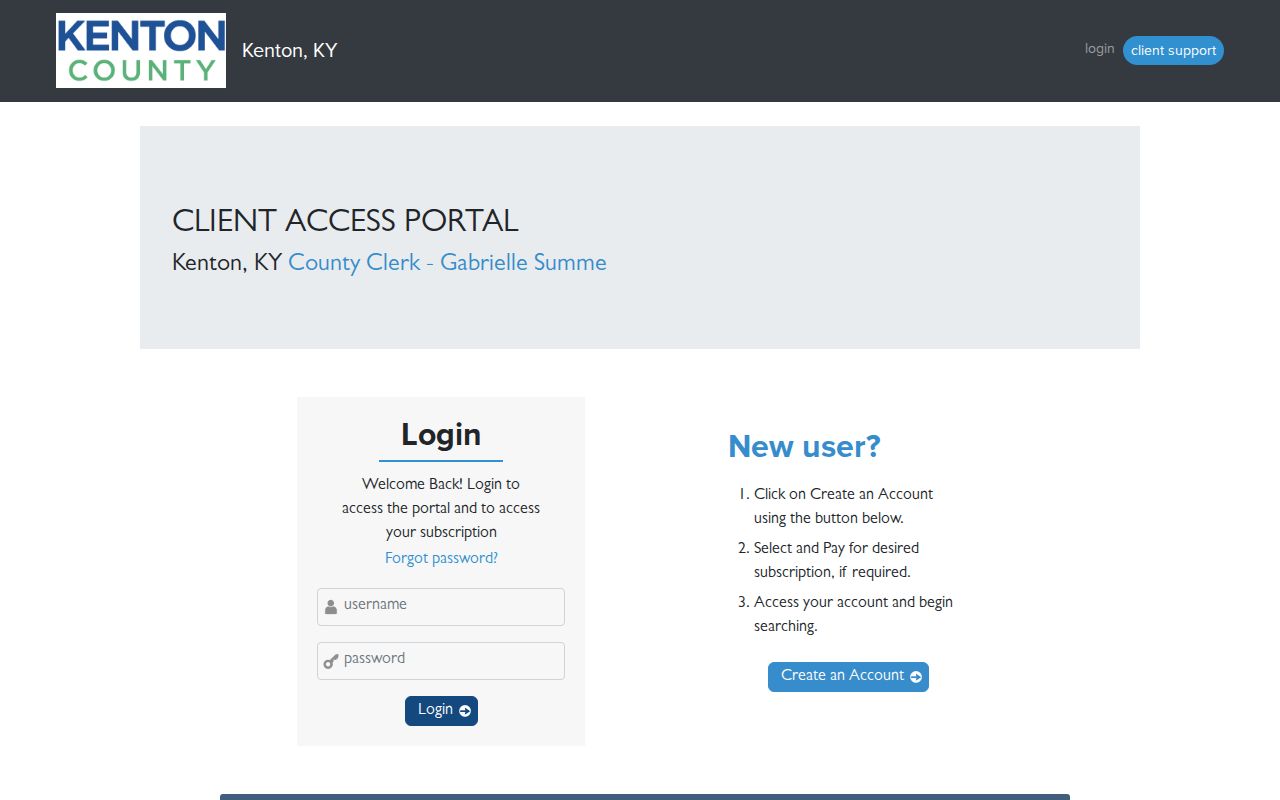
That login surface is exactly why the Clerk's guide and the public record-room computers still matter. They remain part of any complete deed-search route through Kenton County.
| Clue | How it narrows the deed records | Cross-check |
|---|---|---|
| Grantor or grantee | Finds instruments under the transferring or receiving party | Try initials and exact entity variants |
| PIDN | Connects the land index to the PVA parcel | Retain predecessor PIDNs after splits |
| Book and page | Opens a known recording reference | Confirm district and document type |
| Subdivision, section, lot | Locates platted land when address text fails | Compare the Clerk plat and legal description |
Walk the Kenton County Grantor-Grantee Index Backward
A chain of title begins with the latest verified deed, not just the name on the current tax roll. One party may own several tracts. A single parcel may have been split over time. So read the legal description and the prior-reference clause before you chase names further back.
- Use the PVA's current deed reference or PIDN to find the newest conveyance.
- Verify that its parcel description matches, then record the grantee, grantor, date, and reference.
- Search that grantor as an earlier grantee and repeat the description check.
- Move to the proper paper index, deed book, or microfilm when the electronic workflow ends.
- Grantor
- The party transferring the stated interest.
- Grantee
- The party receiving the stated interest.
- Chain of title
- The ordered sequence of instruments affecting the same land.
- Book and page
- A recorded-document locator that can be carried into image browsing.
Two Kenton County Recording Districts Can Hide a Match
Kenton County ran two recording districts. Covington and Independence kept separate recording histories through 2016. Independence has overlapping alphabetical index books spanning 1840 to 1991. Covington relied on group-number deed and mortgage indexes. A district quirk can place a deed in one history. Its related plat can land in the other. The Clerk's own examples include Grandview Summit and Blue Grass Estates Section 3 Plat A359. Those cases show why a failed first search should push you toward the other district. Try the paper index too. Don't assume the document never existed. Note: For land dated before Kenton County's 1840 creation, continue the search in Campbell County records.
Kenton County Plat Numbers Have a 2026 Switch
Plat numbering changed in 2026. The Clerk's plat and older-image guide says plats from 2021 through 2025 sit in Book 1. Plats beginning in 2026 sit in Book 2. Type the six-digit plat number with leading zeroes. Older Covington and Independence images follow their own book, slide, and letter conventions. A no-result screen often just means the wrong book or number format. Compare subdivision, section, lot, and easement language against the current deed. Never let a GIS polygon stand in for the recorded plat.
Older Kenton County Deeds Continue on Film and in Books
The modern computer workflow becomes useful around April 1991. The Clerk points post-2020 inquiry to Kenton Records. Those cutovers do not mark the full age of the records. KDLA's permanent holdings list Kenton deed microfilm for 1840 to 1904. That includes Covington courthouse deeds from 1860 to 1901. Independence deeds run from 1840 to 1904. The Kentucky Department for Libraries and Archives accepts records requests. Many of these take four to six weeks. Search, copying, tax, and postage charges also apply. The Kenton County Public Library holds directories, newspapers, and Sanborn maps. These can untangle name or address variants. None of it can certify a conveyance.
An Erlanger Deed Book Reference Opens a Local Story
Erlanger's history offers one unusually precise landmark. The May 31, 1887 Erlanger Land Syndicate reference appears in Deed Book 47, page 64. It describes a proposed 220-lot plan. Streets named Graves, Commonwealth, Erlanger, Elm, Queen, and Lake appear in the plan. That reference can anchor a real Clerk search for later deeds and plats. Street language shifted over the decades, so names may not match. It is context only. A modern parcel still needs a legal-description comparison before anyone ties it to one of those lots.
Obtain a Kenton County Deed Image or Copy
Start with the document icon in Kenton Records when access is available. Is the image blocked? Maybe the index runs too old. In that case, use a public computer at the Covington Record Room, 1840 Simon Kenton Way, or the Independence office, 5272 Madison Pike. Bring a precise PIDN, party name, date range, district, and book/page whenever you can. The Clerk FAQ is blunt. Staff do not prepare documents. They will not perform title searches. Nor will they give book and page over the phone. Ask the office about current copy and image fees before ordering. A Kentucky resident may also file a precise KRS 61.872 open-records request. Routine self-service may be the answer for indexed material.
Recorded, not guaranteed. Kenton County deed records show accepted instruments, but the index is not a title opinion and cannot reveal every unrecorded interest.
Kenton County's Name Alert Is a Signal, Not Prevention
The Clerk links to a property-fraud alert service. It can send notice when a chosen name shows up in a new recording. That may help an owner spot an unfamiliar filing sooner. It does not block acceptance, validate signatures, or judge whether an instrument is fraudulent. When you register, use the name variants that actually appear on the deed. Include any entity or trust name as well. If an alert points to a document, pull the recorded image. Contact the proper office or counsel rather than trusting the notification alone.
Read Instruments Recorded Beside Kenton County Deeds
A solid Kenton County deed records search looks past the deeds themselves. It also reads what sits beside them. Mortgages secure debt, and a release or satisfaction later clears it. Easements grant someone a use right in the land. Restrictions can bind a parcel no matter what zoning allows. Judgment liens, tax liens, lis pendens, and delinquent certificates each stay on the property records. They remain until a release, court order, payoff, or case disposition discharges them.
Search borrower and lender names around any transfer. Then chase the assignments and releases that follow. A refinance can release one mortgage and record a fresh one the same day. A foreclosure ending in a commissioner deed calls for more digging. Pull the court order, the sale papers, and the Clerk's new recording. Locating the first lien only opens the check; it never closes it.
Keep the Kenton County Legal Description with Every Deed
Two deeds with matching names may still involve different land. Every parcel number belongs on the same chain sheet. So does every deed book and page. The same goes for grantor, grantee, recording date, subdivision, section, lot, acreage, and plat reference. Keep the easement language too. For metes-and-bounds property, preserve every call, monument, stream, road, and distance in the legal description.
Kenton County parcels were sometimes split or combined. In those cases, search both the old and new parcel numbers. A GIS map label that conflicts with the deed is not the last word. Compare the plat, then ask the PVA, the Clerk, or a licensed surveyor. The deed's legal description controls over any web map label.
Work Through Kenton County's Paper Indexes in Order
Start at the public computer. Search by owner or location. Then use F10 for property details and note the current owner of record, the deed book and page, the location, the legal description, and the assessment. Carry that parcel number into Kenton Records. The modern trail can go cold. If it does, identify the right Covington group-number index or Independence alphabetical book instead of browsing at random.
The Independence index books overlap, so check each applicable volume and every name variant. Since about 1890, Kenton County deeds often cite a prior recording. That speeds a backward chain. Older work may lean on tax books, commissioner or sheriff books, probate files, directories, and newspaper notices to surface the next party. Those aids only generate leads; the deed book supplies the conveyance.
Keep a chain worksheet with recording date, grantor, grantee, and deed type. Add district, book and page, parcel number, a legal-description match, and the prior reference. Mark gaps openly. Never join two similar names in silence. A worksheet shows exactly where another index, an estate file, or a court-ordered transfer still needs a look.
A certified copy authenticates the office copy of a deed. It does not turn the Clerk's index into a guarantee of clear title. Keep that distinction in the final chain notes.