
Verify Kenton County’s Owner Record
The Property Valuation Administrator keeps the first view. Each Kenton County parcel has one PIDN. The parcel detail for it shows the exact owner wording. That wording is assessment data. It supplies the keys needed to test the name against the land records. The owner-of-record card captures what to note before leaving the result.
| Field | What the Kenton Roll Shows |
|---|---|
| Current Owner | The name carried for the parcel in the PVA detail |
| Mailing Address | The address used for owner notices, which may differ from the site |
| Property Location | The situs or physical location of the parcel |
| Tax Year | The year attached to the assessment snapshot |
| Current Deed Book/Page | The Clerk reference used to confirm the latest conveyance |
| PIDN and Description | The parcel key and brief legal-description clues |
A Clerk public inquiry computer offers the official self-search route. The guide points to option 5, PVA Real Estate Inquiry. Owner searches take a surname plus first initial. A location search needs number, street, suffix and direction. Results return city, year, owner name and PIDN, and F10 opens fuller detail. Copy the field labels exactly. Never read a mailing address as proof of who lives on the site.
Open Kenton’s Current-Owner Detail
Begin at the official Kenton PVA property-records search. A clean street query works best first. If it fails, drop a direction or suffix, compare the city and legal description, or find the PIDN through LINK-GIS. Similar address text can fill several rows. Match the parcel instead of picking a row because an owner name looks familiar. The official Kenton PVA search page displays the county's public route into its assessment data.
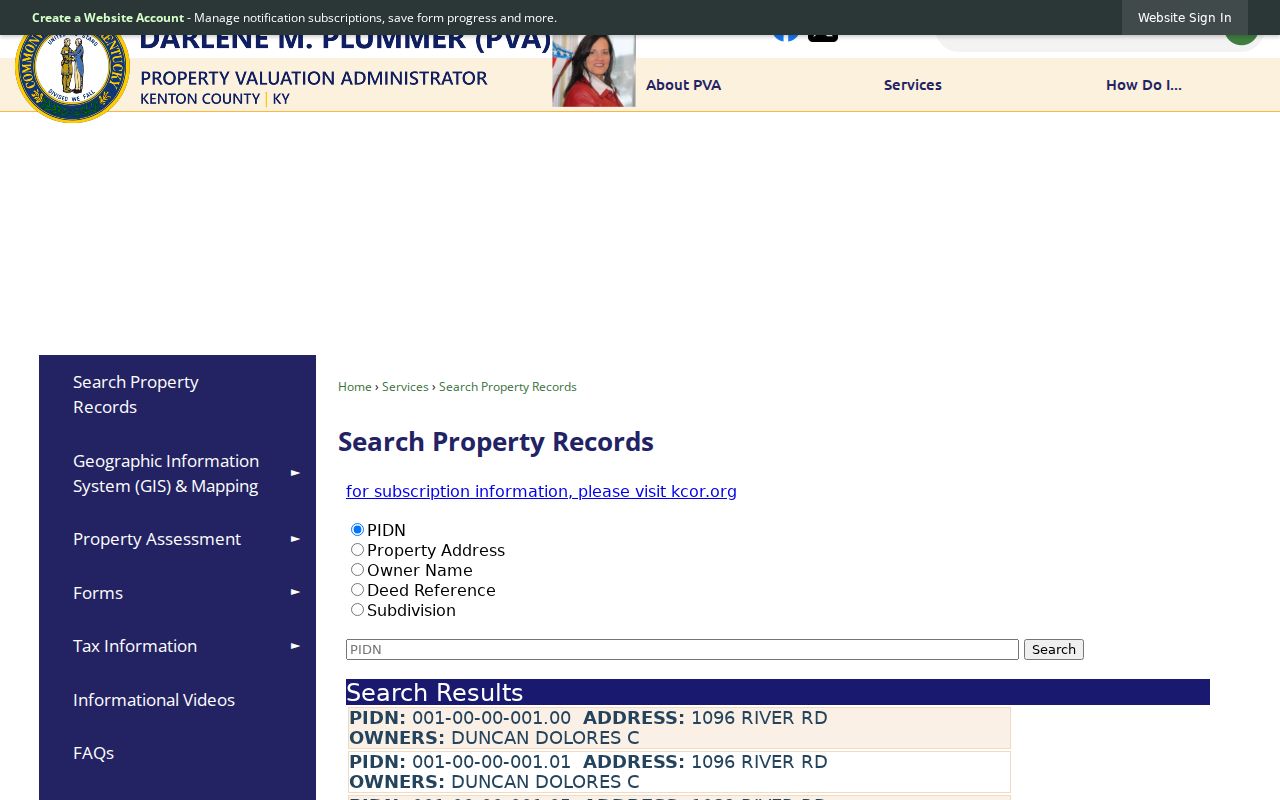
The portal is a starting point. It is not the final word on title. Record the lookup date, displayed tax year, PIDN, exact owner, property location, mailing address, brief description and deed book and page, so the Kenton County check can be repeated if the roll changes later.
Kenton’s January 1 Owner Snapshot
Kentucky property is assessed at fair cash value as of January 1 unless exempt. The Sheriff’s tax search likewise defines the named owner as the owner on January 1 of that tax year. This date label matters. A deed recorded after January 1 may identify a new grantee while the tax-oriented record still carries the earlier party.
Kenton County does not publish an average number of days between deed recording and a PVA owner update. A precise search should preserve that uncertainty instead of inventing a fixed lag. If a transfer is recent, compare dates and use the newest County Clerk deed as the better evidence of the conveyance. The PVA entry remains valuable as the parcel and assessment snapshot.
Note: The Sheriff bill can cross-check the January 1 name, but it does not establish ownership after a later closing.
Confirm Kenton County’s Current Owner
Verification starts with the roll. It ends at the most recent recorded deed, and this narrow present-owner check in Kenton County does not trace every prior transfer.
- Capture the PVA row. Record the current owner, PIDN, situs, tax year and current deed book/page.
- Open the Clerk index. Use Kenton Records or a Record Room terminal and search by PIDN.
- Select the newest deed. Note the recording date, grantor, grantee, deed type, book/page or instrument number.
- Match the land. Compare the legal description, subdivision, lot and acreage with the PVA parcel.
- Resolve a conflict. Ask the PVA about its roll and the Clerk about the recorded instrument when the names do not agree.
Read each record with its date. Dates decide which name controls. For the earlier sequence, the Kenton County former-owner chain carries the full history; this owner-of-record check stops at the latest deed.
Recent-sale caution. The assessment roll can trail a new deed, so rely on neither name without checking its record date.
Kenton Owner Mail and Situs
The situs is the parcel's physical location. The mailing address is where the PVA sends owner notices. The two may match, but they need not. A business entity can take mail at an office, a trust at a trustee's address, and an owner anywhere else. Annexed areas add another wrinkle. Postal city, the PVA city field and the municipal boundary can all differ near those lines.
Keep each field under its own label. An out-of-county mailing address does not mean the owner is absent, and a matching address does not prove occupancy. The PIDN and legal description tie the roll to the deed far better than postal wording. That separation prevents a common Kenton County ownership error.
Read Kenton Entity Owners Exactly
Copy an LLC, trust or estate name verbatim. Search the deed index too. Use the same punctuation, plus any useful name variants, when searching the deed records. The Kentucky Secretary of State business search can clarify organization filings, officers and registered-agent information. Agents and owners differ. A registered agent is not automatically the landowner, and an office address proves nothing about beneficial ownership.
A trust may appear under the trust name, a trustee or both. An estate may be indexed under the decedent, a personal representative or a fiduciary deed. The deed's grantee and vesting language controls. Probate records can explain authority. The owner card should not guess at unlisted beneficiaries or control.
Kenton Current-Owner Terms
A few record terms keep the present-owner check focused. Their meaning depends on the source and the date attached to each label in Kenton County records.
- Owner of record
- The party carried in the PVA parcel record for the stated roll year.
- Assessment roll
- The tax-oriented inventory of parcels, owners, values, maps and exemptions.
- Situs
- The physical property location, distinct from an owner’s mailing address.
- Recording lag
- The interval between a deed’s recording and a later PVA update; Kenton publishes no average interval.
- Grantee
- The party receiving the interest described by the recorded deed.
These labels are not a title opinion. The parcel card is not one either. The PVA may show land value, building value, recorded price, acreage, subdivision and sale dates, yet those fields still hide liens, easements, restrictions and competing claims.
Check Kenton’s Current Owner Offline
If the online detail will not open, contact the PVA at 859-392-1750. Its offices are Suite 3300, 1840 Simon Kenton Way, Covington, and 5272 Madison Pike, Independence. Bring the street address and any PIDN already in hand. For recorded confirmation, the County Clerk Record Room has public computers at the Covington government center. It lists weekday hours of 7:30 a.m. to 4 p.m.
The Clerk's guide says staff may explain computer mechanics. But they do not perform title searches and will not provide book/page by phone. Bring the PVA owner wording, PIDN, and current deed reference. At the terminal, use PVA Real Estate Inquiry and F10, then Kenton Records by PIDN. A precise written request under KRS 61.872 is the fallback for a specifically described public record.
Monitor Kenton Owner Filings
Want notice when something new hits the deed books? The County Clerk links a name-based recording alert through Fraud Alert Me. You submit a name. The service sends word when a recorded document matches it. It cannot block a filing, freeze a deed, or vouch for a record's validity. An alert is really a nudge to pull the Clerk's actual instrument and read it.
Remember what records can and cannot tell you. A current owner result shows no private side agreements and settles no title questions. Use owner and mailing data only for lawful property diligence. Never use it to intimidate, harass, or target anyone. When a deed's legal effect matters, get the official instrument and sound professional advice.