
Identify a Kenton County Owner
Start with the land itself. A street address pinpoints one parcel, so copy its PIDN and read the owner tied to that number. The PIDN is Kenton County's punctuated parcel identifier. It keeps your property search locked to the same tract even when street wording, postal city, or a mailing address shifts.
- Find the parcel. Search the PVA by street number and name, then confirm the parcel address and legal-description clues.
- Save the PIDN. Copy every zero, dot, and suffix exactly as displayed.
- Read the roll. Record the Parcel Owner or Current Owner field with its assessment year.
- Open the newest deed. Carry the PIDN and deed reference into the Clerk index and compare the latest grantee and legal description.
- Resolve any conflict. Ask the PVA about its roll and the Clerk about the recorded instrument when the names differ.
This approach names the assessment owner and checks it against the newest deed. It does not prove anyone lives at the address. It also cannot replace a title search. A buyer, heir, or neighboring owner of record can still build a clear, dated ownership note. These two official sources back it up. Keep a copy of each result and note the retrieval date. That small habit protects the evidence behind your finding if a property record later changes.
Match the Kenton Parcel First
Several Kenton County parcels can share a street name. Others carry the same surname or a near-identical mailing label. Check the house number, street direction, city field, and subdivision lot before trusting a match. LINK-GIS helps orient the parcel when an address search returns several candidates, but its geometry is general reference, not a survey. It is not a survey. Parcel identity matters most after a split or combination. A newer PIDN may be absent from an older deed. The legal description may point to the predecessor tract. Save both numbers when the record offers them. If the owner search returns an entity, keep the entity name exactly as written and follow the deed rather than substituting an officer or registered agent.
Date Every Kenton Ownership Answer
Ownership has no sound answer without a date. The PVA assessment and the Sheriff tax roll owner both tie to January 1. A deed may record later the same year. Kenton County publishes no average lag between deed recording and a PVA update. So invent no grace period. Assume neither source is simply wrong. Record the PVA year, the day of your lookup, and the newest deed's recording date. After a fresh sale, the deed's grantee is the stronger evidence of that conveyance. The assessment roll still delivers the parcel card and tax bill snapshot. Keeping both dates resolves most apparent conflicts. It also makes the property records easy to recheck later.
Open the Kenton PVA Search
The official Kenton County PVA Property Records page gives the county context and the entry point for the parcel lookup.
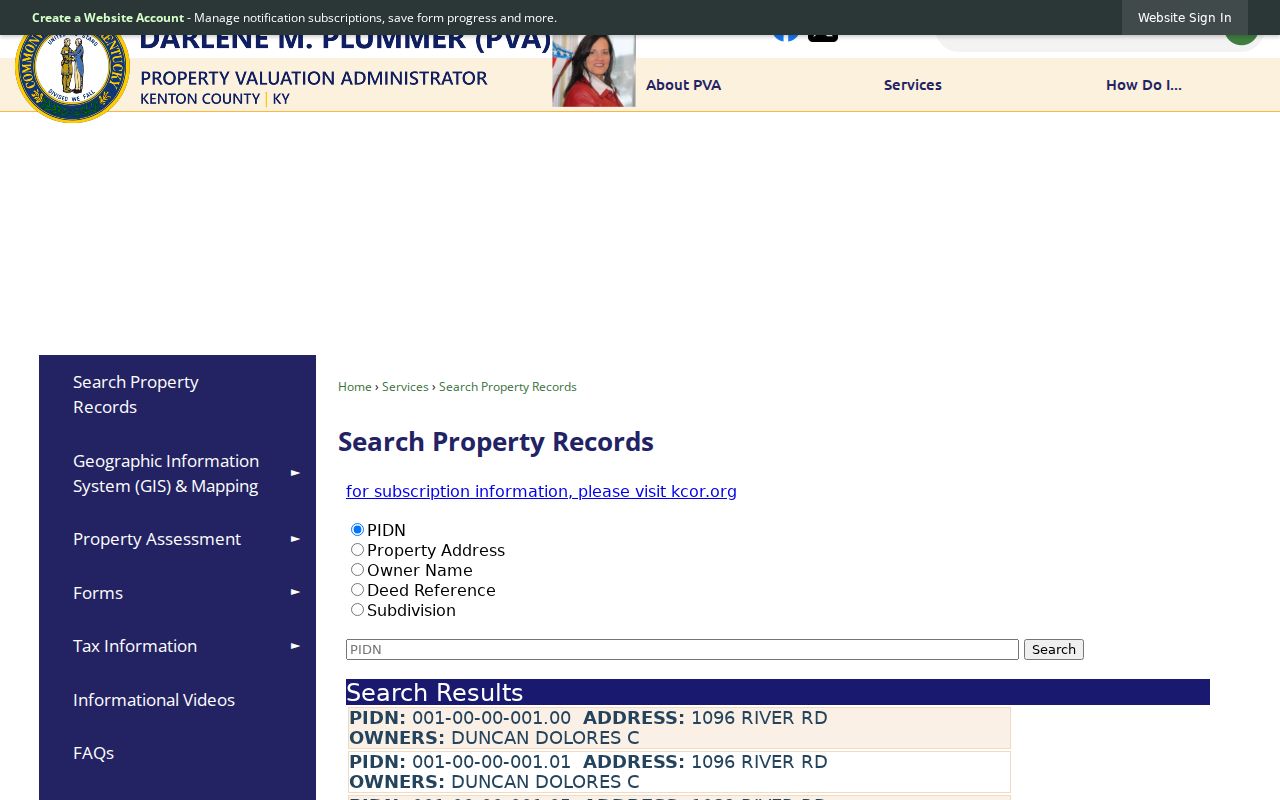
Start there with the property address. Then carry the PIDN and displayed owner together into the Clerk's newest deed.
The Kenton PVA Owner Result Is the Starting Point
The PVA search accepts PIDN, property address, owner name, deed reference, and subdivision. An address result exposes PIDN, Parcel Address, and Parcel Owner. At a Clerk public inquiry computer, option 5 opens PVA Real Estate Inquiry. F10 then shows "Current Owner," the current deed book and page, property location, a brief legal description, and the taxable appraisal. Copy those identifiers before leaving the result. A mailing address can differ entirely from the parcel situs. A postal city can differ from municipal jurisdiction too. The PIDN and legal description bridge you to the deed far more safely than a name or address alone.
Confirm the Kenton County Property Owner in the Newest Deed
The Clerk's 2026 self-search guide points to Kenton Records. That resource covers documents from January 1, 2020 forward. Enter the PIDN, review the instrument list, and open the document icon. Save the recording date, deed type, grantor, grantee, book/page or instrument number, and legal description. A recent conveyance can surface here before the assessment roll catches up. Kenton sources publish no average deed-to-roll update time. Do not assume a fixed delay. Names sometimes disagree. In that case, find the newest properly recorded conveyance. Then ask the PVA about the roll's update status.
Read LLC, Trust and Estate Ownership Literally
An LLC can be the legal grantee. The Kentucky Secretary of State business search explains its public entity filing. A registered agent, though, is not automatically the beneficial owner. Trust property may sit under a trustee or trust name. Estate property may name a personal representative. The deed's vesting language and legal description control. Probate records may explain fiduciary authority. Never substitute a person's name for the recorded grantee in these property records.
Kenton Ownership Terms That Prevent Wrong Matches
- Owner of record
- The name carried on the assessment roll.
- Grantee
- The person or entity receiving an interest in a deed.
- Vesting
- How the recorded instrument says that interest is held.
- Situs and mailing address
- The physical property location and the separate destination for correspondence.
Title is the legal interest in land. A lookup only gathers public clues, so preserve the PIDN's punctuation, zeroes, and decimal suffix. Drop one character and you may select a different parcel.
Offline Routes to a Kenton Owner Record
A dead portal is not a dead end. Kenton County keeps its deed records in the Clerk Record Room at 1840 Simon Kenton Way in Covington. A second office sits at 5272 Madison Pike in Independence. Both are open Monday through Friday, 7:30 a.m. to 4 p.m. Real-estate questions go to 859-392-1650. Bring whatever you have. A PIDN works, and so does a deed reference, subdivision and lot, names, or an approximate year. Staff will explain the computers. They will not run a title search. They will not read a book and page over the phone, and they will not fax and email copies.
Fraud Alerts Monitor Names, Not Ownership
The Clerk links a fraud-detection alert service. It notifies a subscriber whenever a recorded document matches a submitted name. The alert does not prevent fraud. It also does not rule on a document's validity. Inspect the actual filing and contact the Clerk about any activity you do not recognize. It works best once the correct legal owner, trust, or entity name has been identified.
Limits of a Kenton County Ownership Lookup
An owner field has limits. It names the owner of record, not an occupant, and it proves nothing about residence. Easements, restrictions, mortgages, and later filings can all change the picture, so a deed search or full title search still matters. Use public information only for lawful property diligence.
Owner is not occupant. Never use owner information to target, harass or harm anyone.
Resolve Address and Parcel Mismatches
Addresses rarely match across postal, municipal, PVA, and deed systems. If an address fails, strip the direction or suffix. Try the subdivision and lot, or find the polygon in LINK-GIS. Preserve the dotted PIDN. When several results appear, compare city, legal description, and parcel number. Do not pick by name alone. A split or combination may leave a predecessor PIDN behind. Historic directories can explain an old street number, though they cannot prove ownership. The legal description and deed sequence provide the continuity.
Keep an Auditable Kenton Owner Note
Save your trail. Record the query mode, lookup date, PIDN, parcel address, owner field, situs, mailing address, tax year, deed reference, recording date, deed type, grantor, grantee, and legal description. Note whether you opened the image. LINK-GIS adds geographic context. The Sheriff bill adds a January 1 tax snapshot. Neither displaces the recorded deed.
For older documents, search both the Covington and Independence histories, then the paper indexes and KDLA microfilm. Ask the office about current format and fees before ordering. The layered record keeps uncertainty visible whenever a recent transfer or fiduciary deed blocks a one-line answer.