
Reconstruct Kenton County’s Former Owners
Start with the newest deed. Then step back one conveyance at a time, logging each transfer as you go. A transfer table keeps the chain honest, and the entries below show the shape of the fields rather than any real parcel.
| Transfer Date | Grantor to Grantee | Deed Type | Book/Page |
|---|---|---|---|
| Newest recording | Seller to current grantee | Copy exact type | Current deed reference |
| Prior recording | Earlier owner to seller | Copy exact type | Prior reference or index result |
| Earlier recording | Earlier grantor to grantee | Copy exact type | Verified older volume |
For each transfer, record the date, grantor, grantee, instrument type, book and page, price if displayed, and whether an image exists. Then prove the land is identical. A PIDN, subdivision lot, acreage figure, boundary wording, or cited prior deed does that work. A list of surnames proves nothing.
Trace Kenton Former Owners Backward
The County Clerk's self-search guide lays out the route. Begin with what you know. Each deed you pull supplies the next name or reference, and the official portal entry below is the modern gateway that guide names.
- Find the current parcel. Use the PVA address search to capture the PIDN, current owner and current deed book/page.
- Open the newest deed. Search Kenton Records by PIDN and read the document image.
- Take the grantor backward. Treat the grantor as a candidate earlier owner and locate that party’s acquiring deed.
- Follow prior references. Copy any earlier book/page citation and verify the legal description.
- Repeat and log gaps. Continue until the index path ends, then move to paper books, microfilm or court records.
Away from the courthouse, the Kenton County public records login may be blocked.
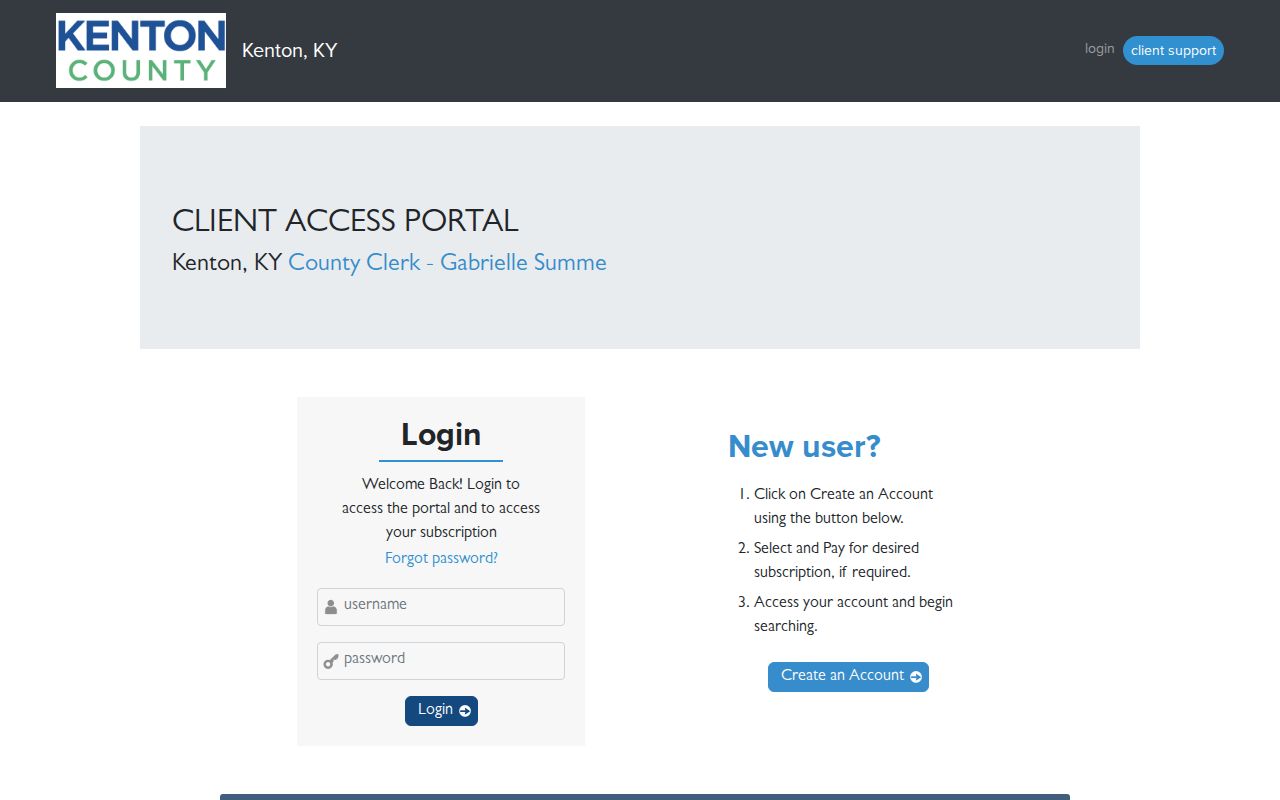
That login wall explains why the Record Room terminal matters. Deeds since about 1890 routinely cite prior recordings. Follow the book/page trail from there. Every link still needs a land match. A deed describes land rather than buildings. Street names change, while subdivision, lot, and boundary wording tends to survive.
Search Kenton Prior Owners Twice
Covington and Independence stayed separate recording districts through 2016. Their older indexes were organized differently. Independence recorded deeds, mortgages, and easements only. Tax, probate, and court material landed in Covington instead. So a failed search in one district does not mean the former owner record is missing.
Each district indexed differently. Covington relied on group-number indexes for deeds and mortgages. Independence used alphabetical grantor and grantee volumes: No. 1 spans 1840 to 1917, No. 2 spans 1911 to 1947, No. 3 spans 1946 to 1978, and No. 4 spans 1978 to 1991. Those overlapping ranges mean boundary years call for two books.
Clerk examples show why both districts matter. Grandview Summit material can split between an Independence slide and a Covington plat. Blue Grass Estates Section 3 Plat A359 carries a Grant and Kenton county track line. The guide also flags Horsebranch, Aosta Valley Subdivision, and Holds Branch/Pioneer Park. Then search both district histories.
How Deep Kenton Owner Records Run
Kenton County split from Campbell County in 1840. Anything earlier may sit in Campbell records. The local chain begins with the two district histories after that. Coverage is layered rather than cut off at one date. Electronic index and public inquiry workflows start around April 1991. PIDN numbers appear as a Covington category from 1994. Searches from January 1, 2020 forward go through Kenton Records.
Deeper history means paper indexes. With a book/page in hand, View Images can recover material a name search misses. Without it, the Record Room's Covington group books lead into the physical deed volumes. The Independence alphabetical books serve the same purpose.
Online is only the newest layer. Pre-1991 chains may require paper indexes, deed books and archival microfilm.
KDLA Extends Kenton Owner History
The Kentucky Department for Libraries and Archives land-record inventory documents Kenton deed microfilm for 1840 to 1904. Microfilm adds real depth. Covington courthouse deeds run 1860 to 1901. Independence courthouse deeds span 1840 to 1904. The inventory also lists tax assessment books for 1840 to 1875 and 1879 to 1892, with Covington volumes for 1887 to 1892.
Tax books can bridge early names. Before about 1890, prior book/page citations get shaky. KDLA also lists Kenton wills for 1858 to 1970. Independence wills begin in 1840. Land-grant and entry material runs roughly 1830 to 1918, though these are finding-aid ranges, not a promise of online searching.
Use the KDLA records-request channel when a volume has transferred to the archive. The base fee is $20 in-state or $25 out-of-state, nonrefundable, with scan, copy, postage, and tax costs added. Expect roughly four to six weeks. Include the county, record type, names, and a narrow date range.
Kenton Estate Transfers Break Owner Chains
A death interrupts the tidy seller-to-buyer chain. The paper trail can grow long. Wills, probate orders, inventories, sale orders, executor deeds, administrator deeds, distributions, and later heir deeds may all appear. Run the decedent, the estate, and the personal representative through the County Clerk index on both sides. Watch for an administrator conveying under wording that differs from the deceased owner's indexed name.
CourtNet works only as a lead. Request the actual probate file from the Kenton Circuit Clerk. The Kenton court office sits at 230 Madison Avenue, Covington, and lists 859-292-6521 with weekday hours from 8 a.m. to 4 p.m. Match the probate authority against the deed that moved the parcel. A death certificate proves the death fact. It does not transfer the land.
Kenton Parcel Splits Hide Prior Owners
A modern PIDN does not always run through Kenton County's full history. Splits do that. A lot split, combination, replat, or boundary adjustment can mint a new parcel key. When that happens, step back from the current deed. Work back to the predecessor legal description and plat. Match subdivision name, section, lot, tract, acreage, easements, and any cited prior recordings.
The Clerk's plat guide has its quirks. Newer plats use Book 1 from 2021, and Book 2 starts January 1, 2026. A search may demand a six-digit plat number with leading zeroes. Older images use COV or IND book types. Independence slides may begin with A, B, or Z. When a known book/page returns "no data found," try View Images. Missing index text does not always mean a missing image.
The deed chain stays primary. A plat explains the parcel's geometry. It can tie a current lot to an earlier tract. It cannot replace the recorded conveyance between former owners.
Kenton Chain-of-Title Terms
Historic indexes speak in compact labels. Recording a code correctly keeps the search from drifting to someone with the same name.
- Grantor
- The party conveying the interest described by the deed.
- Grantee
- The party receiving that interest.
- Chain of title
- The ordered sequence of recorded conveyances tied to the same land.
- Reverse index
- The grantor-side route used to trace an owner and transfer backward.
- Warranty deed
- A deed form carrying stated title covenants that must be read in the instrument.
- Quitclaim deed
- A conveyance of whatever interest the grantor holds, without the same warranties.
KDLA notes that "H" may mark heirs, "C" a commissioner, and "S" a sheriff in an index. Those clues matter. That may explain a missed transfer. Copy the code, inspect the book, then add the confirmed instrument to the timeline.
Kenton Directories Add Street Context
The Kenton County Public Library genealogy collection can crack an address or name puzzle. It shines once the recorded chain is outlined. The holdings run deep. Covington, Newport, and vicinity directories date from 1834, 1839 to 1840, and 1856 forward. The first reverse householder guide dates to 1931 to 1932. Street sections can surface an old number or a spelling. They can also reveal a business tied to a location.
Sanborn fire-insurance maps add footprints and building use. The library holds original 1909 books. Revisions run through the early 1950s. Covington microfilm covers 1963, 1964, and 1980. A database holds Covington sheets from 1886 to 1910. Pair that view with a plat, an assessment book, and a deed. A directory names occupants, not always prior owners. A Sanborn map depicts structures rather than title.
Find Former Owners in Kenton’s Record Room
The Kenton County Clerk real-estate office is the fallback when the portal blocks you or an older index needs hands-on work. The Record Room sits at 1840 Simon Kenton Way in Covington. Another office serves Independence at 5272 Madison Pike. Hours run Monday through Friday, 7:30 a.m. to 4 p.m. The general real-estate phone is 859-392-1650.
Bring the right materials. Pack the current deed, PIDN, prior book/page citations, grantor and grantee name variants, subdivision and lot, and approximate recording years. Clerk staff can explain the computer and the books. They will not run a title search. Nor will they supply book/page by phone, fax, or email copies. Confirm the fee and delivery options first.
Keep the use lawful. Former-owner data fits property and historical research, but the chain can still omit an unrecorded interest or disputed claim, so obtain official instruments and professional help when legal reliance matters.